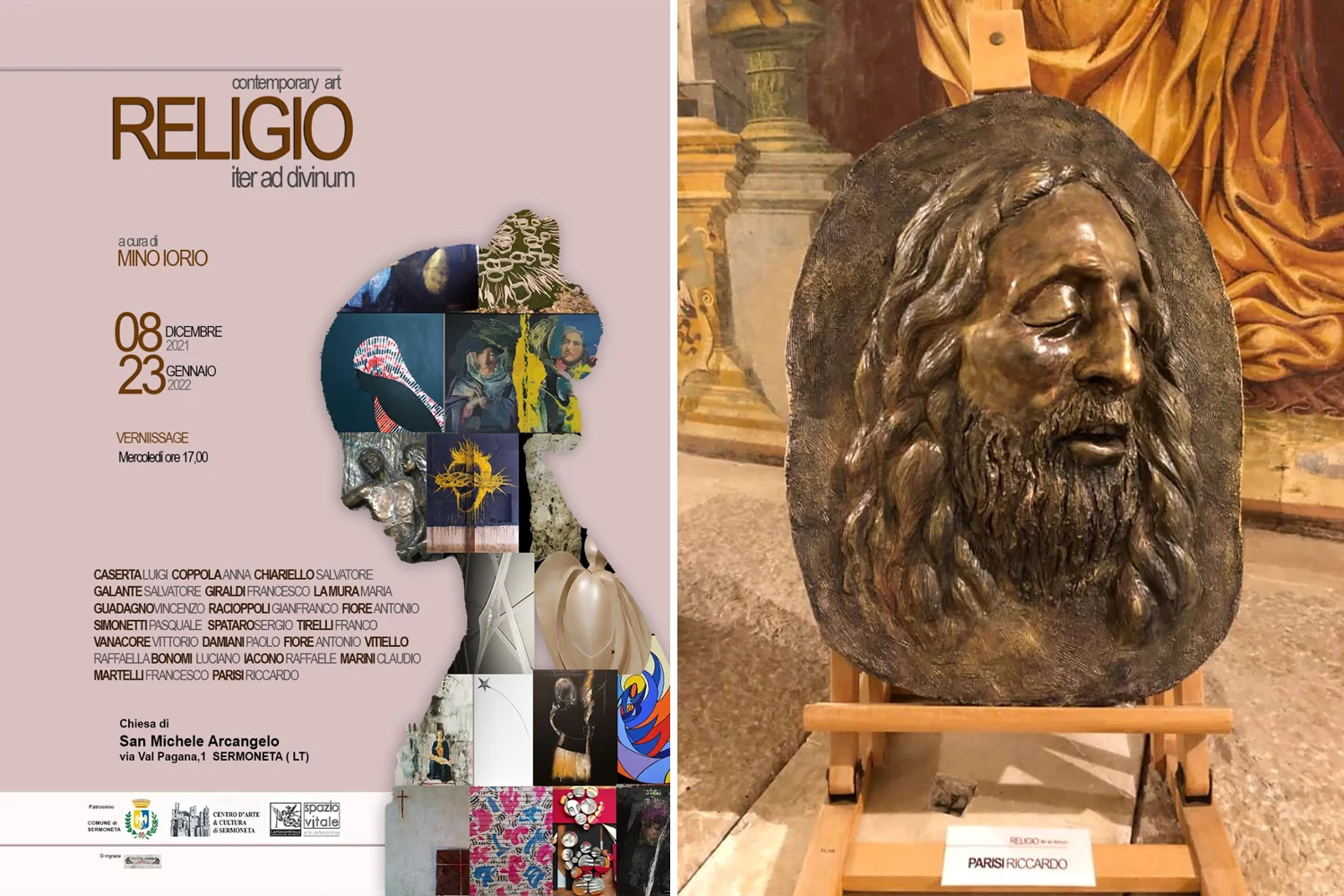
he 8 December, at 17.00 in the spaces of the church of San Michele Arcangelo Sermoneta (LT) will be inaugurated the collective exhibition Religio iter ad divinum inspired by the theme of religion in the universal sense and to which are called to participate with their works more than twenty artists who through the materials and techniques they most congenial openly declare the cultural background from which they come.
A path that allows the visitor to enter into a debate that focuses not so much on a problem of visual perception but on a strictly introspective analysis.
In the proposed works we find above all theological arguments that concern not so much the aspect of fides quae creditur, that is, for the object of the faith, for what is believed, but the aspect of fides qua creditur, or for the way in which the faith is manifested.
A maturation that arises in the intimacy of each individual from the first days of life and generates a whole series of questions that Sigmund Freud, father of psychoanalysis, in some passages taken from Die Zukunft einer Illusion (The future of an illusion) of 1927 explains saying that religion was born to satisfy a childish need for protection where “infantile” and “need for protection” are two key terms for reading the works on display in relation to the process of growth and aspiration to the divine, aspects to which the respective artists have largely referred.
Two different concepts of the world that are opposed, “One considers the child man, in need of a father who directs and dominates him; the other who has confidence in reason and in the autonomous abilities of man”.
As Freud says as an atheist what is “it is worthwhile to attempt an irreligious education […] Man cannot remain eternally a child, sooner or later he must venture into the ‘hostile life’. This can be called education to reality”. And in fact the artists present in this path all try a “irreligious” answer on the theme proposed only to demonstrate their religiosity and formulate a personal answer that would be interesting first of all psychoanalyze.
It is no coincidence that this exhibition was made in an emblematic historical setting, the church of San Michele Arcangelo, a place that does not remain disconnected from the objects it contains and especially if the reference theme for which these works were conceived is the same for which the walls, arches, altars and floors of this building were born, or that fides qua creditur, this becomes the place of choice to present the way in which faith has manifested itself over the centuries with the result that all the stones and all the walls of every corner are imbued with it seamlessly.
In the last analysis from these manifestations the religious belief would be born and Freud right on it intervenes and on its “suspicious genesis” and all this emerges again with force in the works proposed in Religio iter ad divinum.
(m.i.)